I’d like to share my thoughts on tab and notation through my own musical journey.
I had my first guitar lesson at the age of 9. My parents arranged and paid for private lessons as no music lessons were offered at school. During the early stages of my guitar lessons I learnt how to read music – by which I mean music written on staff notation. Tab (or tablature) only came into my musical life much later and by that time my sight reading was proficient enough that I didn’t feel any need to bother with tab. I had learnt all the fingering markings and symbols associated with guitar music and enjoyed the challenge of making my own fingering and positional choices. I didn’t need an image of the fingerboard (tab) to show me where to put my fingers. I would, in fact, have regarded that as a restriction as reading a note, such as E, presents several options on the guitar. It can, for example, be played as an open string (0,1), or 5th fret 2nd string (5,2), or 9th fret 3rd string (9,3). Tab would only have given me only one option and would not have given me the opportunity to explore the fingerboard and the different timbral qualities of the instrument. Tab was really for people who couldn’t read music – and that was not me.
When I took up the ukulele around 2012 my perspective altered. I was grateful that publications such as The Baroque Ukulele by Tony Mizen and The Classical Ukulele by John King included both notation and tab. Tab enabled me to learn pieces quickly even though the fingerboard was unfamiliar. I knew the ukulele fingerboard layout was the same as the guitar but a 4th higher: my open 1st string was no longer E but A, my open 2nd string was no longer B but E, my open 3rd string was no longer G but C and my open 4th string was no longer D but G. Not exactly rocket science but I had to really think about the notes on the ukulele. Furthermore, the open 4th string sounded an octave higher than I expected – due the to re-entrant tuning of a standard ukulele.
Tab enabled me to instantly see where the notes were positioned on the fingerboard – it was an easy option for learning pieces. But playing the ukulele felt a bit like painting by numbers. I decided to apply myself to learning the notes on the ukulele fingerboard so I could play from the notation. This meant I was able to begin arranging and composing for the ukulele. It felt like a win win situation and the hard work paid off in the long run. I learnt the fingerboard by visualising the notes on each string, and at a different positions. I moved on to visualising the notes of different chord shapes in different positions. It’s quite a good mind game if you’re having trouble getting to sleep. Well, it beats counting sheep!
Playing melodies from the notation soon became fluent. But, frustratingly, I still stumbled when reading more complex chord melody pieces as the notes were often clustered together (due to the limited range of the ukulele) and the voicing was not always clear. The high G, and lack of real bass, often challenges chord voicing conventions and makes voice leading difficult. But… the high G is also part of ukulele’s unique charm and distinctive sound. It is both quirky and idiomatic and ideal for playing in campanella style (where the melodic notes are placed on alternating strings). Playing chord melody solos on the ukulele, however, presents numerous challenges for arrangers, composers and players.
Many people who play the ukulele also play the guitar and approach the ukulele as they would a guitar (which perhaps explains why low G tuning is becoming so popular). I also come from a guitar background and while I have applied and adapted my guitar technique to suit the ukulele I regard the ukulele as a different beast. The main point here is that while the high G tuning often makes it difficult to notate correctly for the ukulele, it facilitates a unique and distinctive soundscape and style of playing. Let me elaborate.
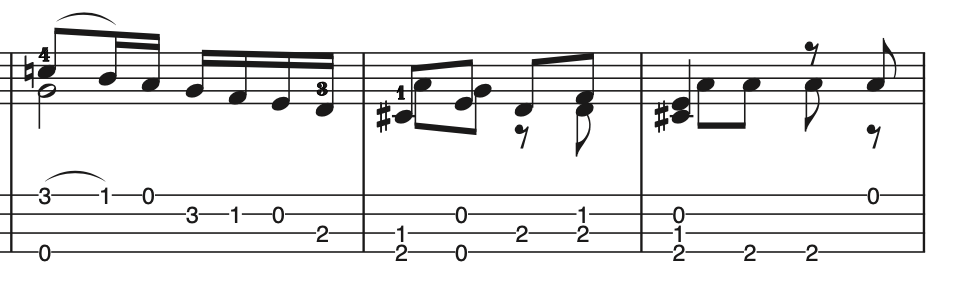
The passage below provides an example of notational anomalies created by the re-entrant tuning. The glaring issues occur in the 2nd and 3rd bars where the notes on the 4th string sound higher than the melodic notes. In the tab part the voices look correct. But the notation looks, and is, technically speaking wrong. How do we correct this situation? One solution would be to use a low G. But in doing so we would change the natural and authentic voice of the ukulele. This begs another question: in changing the voice of the instrument are we changing the instrument itself? I’ll let you dwell on that!
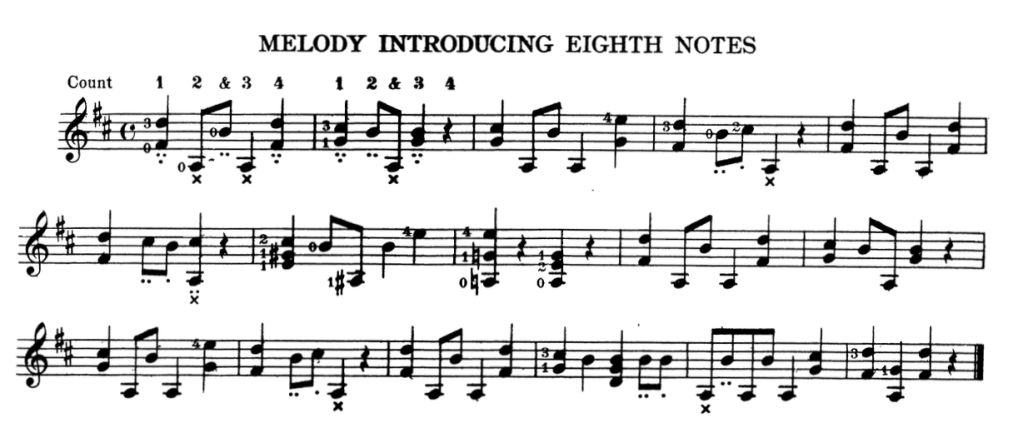
The problem of notating for the high 4th string is not a new dilemma. In 1920 The Bickford Method for the ukulele addressed this problem by notating the notes on the 4th string an octave lower than they sounded. We can see this in the following example (which uses D6 tuning). The notes on the 4th string are clearly identified as being the lowest. Well, they might look to be the lowest but when played they do not sound as written – which is also quite confusing. The Bickfords didn’t worry about separating the voices – tut tut. Their solution, which isn’t such a bad one, obviously didn’t catch on as nobody uses that approach today. So, here we are 100 years later and we are still debating when, if and how to use tab and/or notation.
As already mentioned another situation where tab makes sense is when playing in campanella style. In the next example the melodic notes are placed on alternating strings to create the over-ringing effects of campanella technique. This is very clearly shown in the tab.

If we were only using notation (as the example below shows) we would need to use a considerable number of fingering indicators and symbols. The music would look very crowded and, ironically, we would have overlaid our notation with another form of tab!

The majority of ukulele scores being published (or self-published) today include both tab and notation. In the majority of cases this would seem to be a suitable compromise – a happy medium. The ukulele is very popular with adult learners and tab makes the ukulele accessible and clarifies the role of the high G. I have used tab extensively in my own workshops and am a big fan of tab. I hasten to add that all of my workshops have been tailored for adult leaners and hobbyists.
But what about teaching children the ukulele? In recent years the ukulele has continued to replace the recorder as the first choice instrument for children in schools across the UK. This is wonderful news for the ukulele: an instrument which has struggled to be recognised as a legitimate instrument. Many music examination boards now include a ukulele syllabus. On the surface this seems like good news but a quick review of all the main music exam bodies in the UK reveals that they all are using tab and notation even at the early stages of learning. If the ukulele is being used to introduce children to music why are we encouraging them to learn tab – a diagrammatic instrument specific system – rather than standard music notation – a universal system which will enable them to participate and communicate with other musicians and transition to other instruments?
The argument that scores include both notation and tab doesn’t really cut it: given two choices it is human nature to choose the easiest option – which, of course, is tab. It also seems rather ridiculous to me that tab is even deemed necessary for learning a simple melodic line in an early grade. Surely this is the ideal time and opportunity to be teaching children how to read music? Once they have grasped the basics they can then either continue learning the ukulele (and play more complex pieces using tab and notation) or transition to other instruments. Imagine a child who has learnt to play the ukulele from tab and who then wants to learn the violin, or the flute, or the guitar? They will have to start from scratch by learning how to read music. They will have learnt to play the ukulele, but they will not have learnt music. They will be musically illiterate. This is not a good situation for either the child (who will be confused), the parent (who may have been paying for lessons) or the ukulele (which will look simplistic and obscure). And it is certainly not a good look for a music exam board.
It is time, I think, for music teachers and music examination boards to stop and think about their approach to teaching young children the ukulele and the consequences of promoting a diagrammatic instrument specific system. While there are many instances where tab is a viable option, early learning is surely not one of them. I feel we have to draw a line somewhere and so for the reasons given here I recently declined a commission from a well known music exam board as, despite my concerns, they are committed to including tab in a series of exam books aimed at young children. Their main argument is accessibility and inclusivity. This is a short term fix because in the long run children will not have learnt a musical language that will enable them to communicate and participate with other musicians. How will they be able to compose or arrange music? What if they want to go on and study music at tertiary level? Thinking back to my first guitar lessons I am hugely grateful that I was taught how to read music and not just tab. Without the ability to read music I would not be here today. I would not have been able to study at the Royal College of Music and I would not have been able to do a PhD on the ukulele. While I realise not everyone will want to do these things, they are the things I love and cherish. Education is about providing opportunities that enable young people to make their own choices.
I realise I am probably a lone voice in the wilderness and others will gladly contribute to this exam but my priority is my belief in the ukulele and determination to promote it as a legitimate instrument. If all the other instruments in this exam series are required to learn notation, why is the ukulele being singled out and given a soft option? It’s beginning to look like a further denigration of the ukulele – a rubber stamping of the idea that the ukulele is not, after all, a legitimate instrument. We’re not just talking about a group of children having fun in their ukulele group at school – I’m all for that! We’re taking about a well known musical examination board with an international reputation. What is the point of having an exam system if it is not to award the attainment of certain standards and ensure a thorough education? Encouraging children to learn tab rather than notation is a cop-out at the highest level. The inclusion of tab might make these books more appealing and accessible – but is this for the benefit of the pupils or the teachers?
I leave you with the words of Vahdah Olcott-Bickford & Zarh Myron Bickford, 1920:
‘Any instrument which is worthy of having an instruction book written for it, is of course worthy of being written for in the legitimate notation’.
I am despondent but don’t worry. I have not spent the last 12 years of my life fighting to prove the ukulele is a serious and legitimate instrument only to give up now!
Here’s me playing my arrangement of Prelude BWV 1007 by Bach.
 I Love Classical Ukulele
Hello and thank you. When I read tablature alone, the rhythm doesn’t appear as clearly as when using academic notation. In my humble opinion.
LikeLiked by 1 person
Good morning Samantha!
I couldn’t agree more. I am a musician my self having played the clarinet since the age of 7. I am grateful for all of the time I spent as a child and now as an adult learning to read music. As an adult I have been able to learn to play the piano, the guitar and now the the ukulele. I was thrilled to find your website and have spent many hours enjoying your classical arrangements for the ukulele. I have probably short-changed myself by relying heavily on tab with the guitar and uke, but you have inspired me to slow down and spend time with the fretboard. Thank you for everything you do!!
LikeLiked by 1 person
I totally agree Samantha and would propose taking it one step further. For notation learning purposes….I would like to see the Teaching Ukuleles have Low G tuning. This would take a lot of the confusion of high G tuning off the table and would give more notes on the scale to work with. High G tuning could be added at a later time.
Cheers, Jim Thornton
LikeLiked by 1 person
I concur wholeheartedly with your assessment of the situation. I taught classical guitar for twenty plus years before arthritis caused me to give it up and have been playing ukulele (primarily a concert size) for the last seven years. My primary complaint about uke players I have played with is a lack of ambition to learn to read. So many don’t know the notes of the fingerboard and don’t seem motivated to learn. Much of this is due (I think) to the emphasis at workshops that ukulele is SO easy and fun to play. While this is true, it can be so much more.
Sorry for my rant. It is a hot button for me I guess.
BTW, I found it fascinating that the Bickfords had a ukulele lesson book. I used to have their classical guitar books.
With best wishes, Ramille Matsoukis
LikeLiked by 1 person
Keep fighting the good fight, Sam!
LikeLiked by 1 person
Great reasoning. I learnt music for the piano and find it much better to have both tab and notation for the ukulele. It also helps with interpretation. Thank you for your dedication and the wonderful pieces you play.
Clare Reid
LikeLike
Hello Sam,
I began classical guitar lessons in my mid thirties and found it relatively easy to learn musical notation on the instrument. I continued with my lessons on and off for the next eight years or so but finally, and a bit regretfully, stopped. A couple of decades later I purchased my first ukulele and I just adored everything about the uke – it’s size, portability, comparatively low cost, i.e., but in my few feeble attempts to learn notation I quickly fell back into reading tablature. This bothers me. It is, as you said, a little like paint by numbers! I have considered taking private lessons but I would prefer to learn from a book at my own pace. Would you be able to recommend one suitable?
Grateful for your music and this recent post of yours,
Anne
LikeLike
I found this very interesting. I also came to classical ukulele from classical guitar and was very familiar with guitar notation*, but also struggled with re-entrant tuning. I recall attending one of your workshops where you taught me not to be ashamed of using tablature as an adjunct to standard notation – thank you!
* I play other instruments from standard notation.
LikeLike